

Bar Chart (biểu đồ cột) là dạng rất hay gặp trong IELTS Writing Task 1 Academic. Bài này đi qua trọn vẹn một đề Bar Chart không có mốc thời gian thay đổi: phân tích đề, dàn ý, bài mẫu band 7+, phân tích theo 4 tiêu chí chấm, cụm từ so sánh đáng học và bài tập để bạn tự luyện.
Đề bài
The bar chart below shows the average number of hours per week that people in three age groups spent on four leisure activities in one country in 2025.
Summarise the information by selecting and reporting the main features, and make comparisons where relevant.
Write at least 150 words.
(Đề do IELTS Ngọc Tỉnh biên soạn theo phong cách IELTS; số liệu minh họa, không phải số liệu thống kê thật.)
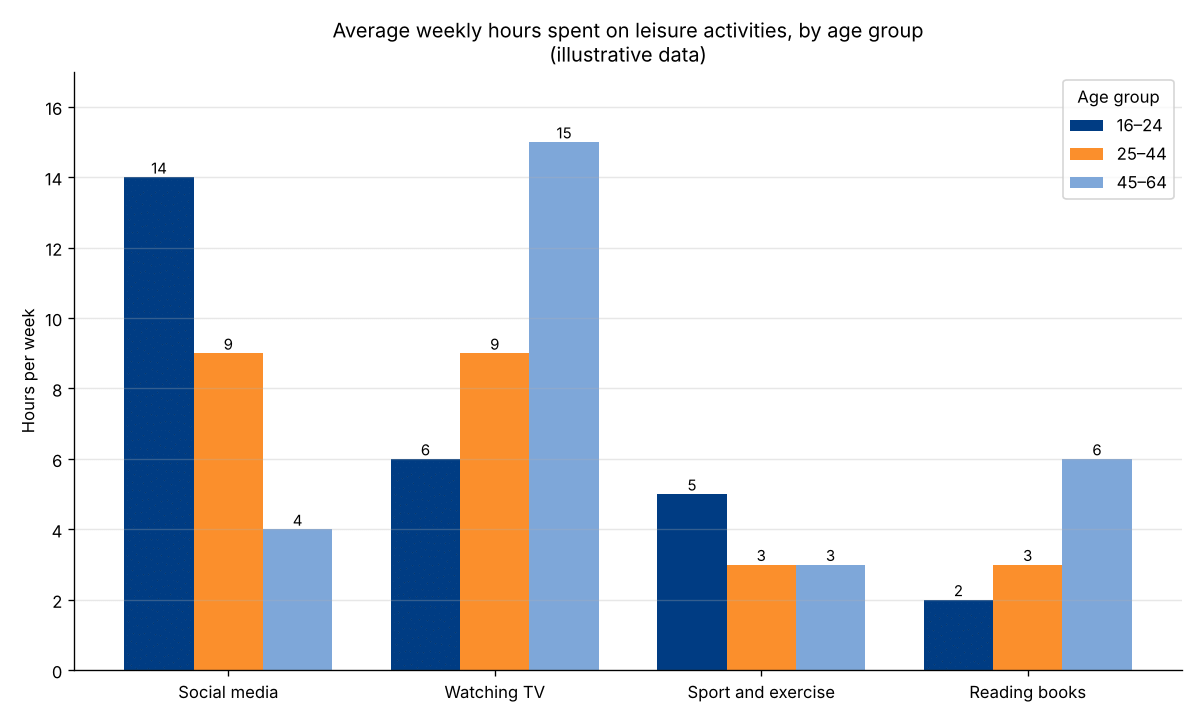
| Hoạt động (giờ/tuần) | 16–24 | 25–44 | 45–64 |
|---|---|---|---|
| Social media | 14 | 9 | 4 |
| Watching TV | 6 | 9 | 15 |
| Sport and exercise | 5 | 3 | 3 |
| Reading books | 2 | 3 | 6 |
Phân tích đề: biểu đồ này khác gì biểu đồ đường?
- Không có trục thời gian: số liệu chỉ thuộc một năm (2025), nên trọng tâm là so sánh, không phải mô tả xu hướng tăng – giảm theo năm. Tuy vậy, có thể mô tả sự thay đổi theo độ tuổi (rose with age, declined with age).
- Thì động từ: dùng quá khứ đơn vì năm 2025 đã qua (spent, was, rose).
- 12 con số: không cần nhắc hết theo thứ tự, mà nhóm lại để làm nổi bật điểm chính.
- Cách nhóm hợp lý: 2 hoạt động màn hình (social media, TV) có xu hướng ngược nhau → một đoạn; 2 hoạt động còn lại (reading, sport) → một đoạn.
Dàn ý 4 đoạn
- Mở bài: paraphrase đề (the average number of hours per week → how many hours per week, on average).
- Overview: người trẻ dành nhiều thời gian nhất cho mạng xã hội; nhóm lớn tuổi nhất chủ yếu xem TV; thể thao chiếm ít thời gian ở mọi nhóm.
- Thân bài 1: social media giảm theo tuổi (14 → 4), TV tăng theo tuổi (6 → 15), nhóm 25–44 chia đều 9–9.
- Thân bài 2: đọc sách tăng theo tuổi (2 → 6); thể thao cao nhất ở người trẻ (5) rồi còn 3 ở hai nhóm lớn tuổi.
Bài mẫu band 7+ (khoảng 200 từ)
The bar chart compares how many hours per week, on average, people in three age groups spent on four leisure activities in one country in 2025.
Overall, social media was by far the most popular pastime among 16- to 24-year-olds, whereas television dominated the free time of those aged 45–64. Screen time therefore shifted from online platforms to TV as age increased, while sport and exercise accounted for relatively little time in every group.
Looking first at screen-based activities, the youngest group spent around 14 hours a week on social media, more than three times the figure for the oldest group (4 hours). The pattern for television was the reverse: viewing time rose steadily with age, from 6 hours among 16- to 24-year-olds to 15 hours among those aged 45–64. People in the 25–44 bracket divided their time evenly between the two, at 9 hours each.
As for the other two activities, reading followed a similar upward trend to television, increasing from just 2 hours a week in the youngest group to 6 hours in the oldest. By contrast, sport and exercise was most popular among young people, at 5 hours, before falling to 3 hours for both older groups, making it the least time-consuming activity for those aged 45–64.
Phân tích bài mẫu theo 4 tiêu chí chấm
Task Achievement
Overview nêu được 3 đặc điểm lớn nhất mà không dùng số liệu: mạng xã hội ở người trẻ, TV ở nhóm lớn tuổi, thể thao thấp ở mọi nhóm. Thân bài dẫn số liệu chọn lọc và so sánh (more than three times the figure for…), không liệt kê máy móc 12 con số.
Coherence and Cohesion
Mỗi đoạn thân bài có một nhóm hoạt động rõ ràng, mở đầu bằng cụm dẫn dắt (Looking first at…, As for…). Các từ nối whereas, by contrast, therefore dùng đúng chức năng; the reverse, the two là cách tham chiếu giúp tránh lặp từ.
Lexical Resource
Không lặp “activity” liên tục mà thay bằng pastime, free time, screen-based activities. Cách gọi nhóm tuổi cũng đa dạng: 16- to 24-year-olds, the youngest group, those aged 45–64, the 25–44 bracket.
Grammatical Range and Accuracy
Có câu phức với whereas, cụm phân từ making it the least time-consuming activity, cấu trúc so sánh bội số more than three times the figure for, và cách dùng dấu hai chấm để giải thích (The pattern for television was the reverse: …). Thì quá khứ đơn được giữ nhất quán.
8 cụm từ đáng học cho Bar Chart
- by far the most popular – phổ biến nhất, bỏ xa phần còn lại.
Ví dụ: Cars were by far the most popular means of transport. - dominate – chiếm phần lớn, áp đảo.
Ví dụ: Coal dominated electricity production in 1990. - more than three times the figure for – gấp hơn ba lần số liệu của.
Ví dụ: Spending on rent was more than three times the figure for food. - the pattern was the reverse – xu hướng ngược lại.
Ví dụ: Men preferred football; for women, the pattern was the reverse. - rise steadily with age – tăng đều theo độ tuổi.
Ví dụ: The proportion of homeowners rose steadily with age. - divide (time) evenly between – chia đều (thời gian) giữa.
Ví dụ: The budget was divided evenly between health and education. - follow a similar upward trend to – có xu hướng tăng tương tự.
Ví dụ: Train use followed a similar upward trend to bus use. - account for relatively little – chiếm tương đối ít.
Ví dụ: Renewable energy accounted for relatively little of the total.
Lỗi hay gặp với đề này
- Không có overview hoặc overview chỉ là số liệu: ❌ Overall, young people spent 14 hours on social media. → ✅ Overall, social media was by far the most popular pastime among young people. Theo band descriptors, band 7 cần “a clear overview”.
- Mô tả như có trục thời gian: ❌ Time spent on social media decreased over the period. (biểu đồ chỉ có một năm, không có “giai đoạn”). ✅ Time spent on social media declined with age.
- Sai cách viết nhóm tuổi: ❌ 16-24 years old people → ✅ 16- to 24-year-olds hoặc people aged 16–24.
- Sai giới từ với “spend”: ❌ spent 14 hours for social media → ✅ spent 14 hours on social media.
- Thêm ý kiến cá nhân: ❌ This is because young people are addicted to phones. Task 1 chỉ mô tả số liệu, không giải thích nguyên nhân.
Bài tập nhỏ
Dựa vào bảng số liệu trên, sửa hoặc hoàn thành các câu sau.
- Điền từ: The 45–64 age group spent five times as many hours watching TV ______ doing sport. (as / than / to)
- Sửa lỗi: People aged 25–44 spent 9 hours for watching TV.
- Viết lại câu dùng whereas: Young people preferred social media. Older people preferred television.
- Đúng hay sai so với số liệu: Reading was the least popular activity in every age group.
Đáp án: 1. as (cấu trúc five times as many … as; 15 giờ xem TV so với 3 giờ thể thao đúng là gấp 5 – luôn kiểm tra phép tính trước khi dùng so sánh bội số). 2. spent 9 hours watching TV (spend + time + V-ing) hoặc spent 9 hours on TV. 3. Young people preferred social media, whereas older people preferred television. 4. Sai – đọc sách ít nhất chỉ ở nhóm 16–24 (2 giờ); ở nhóm 25–44 đọc sách bằng thể thao (3 giờ), còn ở nhóm 45–64 thể thao mới là thấp nhất.
Tóm tắt nhanh
- Bar Chart không có trục thời gian: trọng tâm là so sánh, có thể mô tả thay đổi theo nhóm (tuổi, quốc gia…).
- Overview nêu đặc điểm nổi bật nhất, không dùng số liệu.
- Nhóm các hạng mục có xu hướng giống hoặc ngược nhau vào cùng đoạn.
- Dùng cụm so sánh như by far, more than three times the figure for, the reverse và kiểm tra phép tính.
- Không giải thích nguyên nhân hay đưa ý kiến cá nhân trong Task 1.
Bạn muốn biết bài Task 1 của mình đang ở band nào và cần sửa điểm gì trước? Nhắn Fanpage IELTS Ngọc Tỉnh để được kiểm tra trình độ và tư vấn lộ trình miễn phí. Nếu bạn đang ở 5.5 và hướng tới 6.5, lớp Level 4 – Mind Boost (Tăng tốc), 5.5 → 6.5 luyện Writing có chữa bài chi tiết. Xem thêm: Bài mẫu Writing Task 1 Line Graph: lượng khách tham quan 3 bảo tàng.



Để lại một bình luận